The EIA (Environmental Impact Assessment) Report for an Investment
Proposal (IP) for “Extraction and processing of polymetallic ores from the
‘Rozino exploration area‘ –Tintyava deposit,” located in the area of the
villages of Rozino and Gugutka, Ivaylovgrad Municipality, Haskovo District
TO:
The Minister of Environment and Water
Mr. Yuliyan Popov
The Minister of Foreign Affairs
Ms. Nadezhda Neinska
The Director of RIEW (Regional Inspectorate of Environment and Water) – Haskovo
Eng. Tonka Atanasova
The Director of BDIBR (East Aegean River Basin Directorate)
Eng. Vasil Uzunov
CC:
The Mayor of Ivaylovgrad Municipality
Ms. Diana Ovcharova
The Mayor of the village of Rozino
Mr. Ali Kyuchyuk
OBJECTION
Against:
The EIA (Environmental Impact Assessment) Report for an Investment Proposal (IP) for „Extraction and processing of polymetallic ores from the ‘Rozino exploration area’ –Tintyava deposit,“ located in the area of the villages of Rozino and Gugutka, Ivaylovgrad Municipality, Haskovo District
Submitted by: Association „Balkanka,“ Sofia, 26 Chelopeshko Shose St.
Ladies and Gentlemen,
Having in mind the notification published on the website of the Ministry of Environment and Water, in which the miserable Environmental Impact Assessment (EIA) Report in view is uploaded, bearing the typical for such schemes in our country „quality“, we hereby inform you that we strongly protest to the implementation of the investment proposal in question in general, and in particular to the content and conclusions of the authors of this EIA Report.
Should you wish to review it, you may find the notification at the following link:
https://www.moew.government.bg/bg/doklad-za-ovos-za-investicionno-predlojenie-dobiv-i-prerabotka-na-polimetalni-rudi-ot-nahodiste-rozino-plost-tintyava-razpolojeno-na-teritoriyata-na-s-rozino-i-s-gugutka-obstina-ivajlovgrad-oblast-haskovo/
The grounds for objection are as follows:
1. We oppose to the sources of information used in the preparation of this pathetic document.
For example, the authors of the EIA Report are not even aware of which is the River Basin the project actually falls within, as the mine is located in the village of Rozino, Ivaylovgrad Municipality, Haskovo District!
Confirmation of this unfortunate fact can be found on page 73 of the EIA Report, where the following is literally stated:
„To-date information on the condition of the groundwater body is based on the Annual Bulletin on the status of surface and groundwater bodies in the West Aegean River Basin for 2022 (published on 12.05.2023).“
To the information of the „competent“ (or not) Ministry of Environment at Maria Luiza Blvd. 22, as well as of the authors of this EIA Report: the village of Rozino, Ivaylovgrad Municipality, Haskovo District, together with the Byala reka River, within the catchment area of which this devastating mine will be developed, fall entirely within the region of the East Aegean River Basin (EARB), not in the West Aegean River Basin! Do you even read these reports before publishing them for public consultation?!
From the above, a legal conclusion follows automatically: the Environmental Impact Assessment has been carried out for a groundwater body within the Eastern Aegean Basin, but based on information taken from a bulletin concerning the Western Aegean Basin. This means that the EIA Report in question is a complete sham, built on false and irrelevant information. In other words, the Report is equal to the absolute Zero.
It is entirely unclear to us HOW and WHY this EIA Report was given a positive assessment by the competent authority, which has had the audacity to publish it for public consultation, as if the public concerned has nothing else to do than to cope with the misconduct of the Ministry of Environment and Water.
Therefore, we hereby insist that the EIA procedure should be terminated right away!
Nevertheless, despite the above fatal flaw in the EIA Report, in order to facilitate your future pointless efforts regarding this particular investment proposal, we will share below additional arguments explaining why this mine cannot be realized, substantiated by the available and/or missing data in the published EIA Report, as follows:
2. We object to the statements on page 46 of the EIA Report, which claim:
„From the conducted hydrological survey, defined in the hydro geological report, regarding the availability of water resources from surface water bodies, it is proven that in the period January–May, when the river has sufficient water flow, there is a possibility to use water from Arpa Dere River, in the area of the Rozino Pump Station (PS), at a rate that can provide a minimum of 50 l/s (expected total volume 648,000 m³), equivalent to 10% of the long-term average water flow, as well as to guarantee the ecological minimum in the river. During this period, the open reservoir for non-contact water will be filled by constant water extraction.“
2.1.
First, it is not proven that the „sufficient“ flow in the river during January–May can actually provide 50 l/s in any dry year, when there is little or no rain or snow during these months. In dry periods Arpa Dere River barely trickles and almost dries up! And indeed, it dries up completely in the summer, as stated on page 101 of the EIA Report itself.
2.2.
Second, the Report itself claims explicitly that these 50 l/s correspond to 10% of the long-term average water flow, and that by extracting this amount of water, some so-called „ecological“ minimum can be guaranteed. Here, we draw your attention to the following set of problems:
- The concept of an „ecological“ minimum does NOT exist within the relevant legal framework. What exists is the minimal allowable flow, defined under Article 117(1) in relation to §125 of the Transitional and Final Provisions of the Water Act.
- The minimal allowable flow is exactly equal to 10% of the long-term average flow and must not be less than the average minimum monthly flow with 95% reliability at the point of future water intake from Arpa Dere River.
- The authors of the EIA Report clearly declare their intention to extract water in January–May equal to 10% of the long-term average flow. This directly violates Article 156e(3) of the Water Act. This is because nothing guarantees that in dry or very dry years, 10% of the long-term average flow will actually run in the river during January–May. In fact, the authors of the Report apparently assume that at least 20% of the long-term average flow will always be present in the river during January–May, so that taking half of it (i.e., 10%) would leave the required 10% minimum in the river. However, the EIA Report states that the „ecological minimum“ – whatever that means, i.e. the minimal allowable flow is 50 l/s and that this amount will be fully extracted, meaning that nothing will remain to run in the Arpa Dere River in dry years!
- To comply with Article 156e(3)(2)(a) of the Water Act, the EIA Report should have ensured that measures under the River Basin Management Plan (PoM of RBMP 2022–2027) for the East Aegean River Basin are implemented to guarantee that the sum of the project water intake and already permitted water extractions does not exceed 60% of the permanent freshwater resources, with 95% reliability for the river basin in question.
This section demonstrates that the assumptions in the EIA Report about water availability are legally and technically unfounded, making its conclusions unreliable and the proposed project unsustainable.
Therefore, we hereby warn all authorities, and especially the mayors of the village of Rozino and the Ivaylovgrad Municipality, THAT the water extraction described in the EIA Report—50 l/s from Arpa Dere during the period January–May will guarantee the drying up of the river during the same period in dry years, with all the consequences not only for the life in the river but also for the supply of the Rozino Pump Station with fresh water during the named period! And Arpa Dere dries up anyway in summer, leaving only puddles and pools in the riverbed. The mayors should tell the „competent“ authority whether water is even being taken from Arpa Dere at the Rozino PS in the summer. Otherwise, no one should complain afterwards, as people are currently complaining about the same problem in Breznik! Or like they complained in Krumovgrad when they ran out of drinking water in the ground water sources in 2023. If you have not understood what is this all about, here is the source:
https://vik-kardzhali.com/news/152
And yet again, just for the same mayors, we must point out THAT at the time when the Krumovgrad drinking sources died, the Ada Tepe mine was allowed to take water from the wells in the Krumovitsa terrace, which are located upstream from the drinking wells for Krumovgrad, and the mine’s own wells did not dry up, think about it why! And no one should believe that if the mine is only allowed to take water from Arpa Dere from January to May, they will not take water in the remaining months when it is possible. They will take as much water as they need, and the controlling authorities will not dare to touch them!
2.3.
Third, the EIA Report does not specify what this „ecological“ flow in Arpa Dere is supposed to be.
2.4.
Fourth, regarding the existing Rozino drinking water pump station: taking surface water will negatively affect the quantitative status of the groundwater body, since in this case surface and groundwater are hydraulically connected. You will understand why further below.
3. We object to the statement on page 46 of the EIA Report, which states:
„As a possible option for water intake, a pumping station can be constructed in the area of Rozino PS, which is used to supply drinking water to the village of Rozino. Due to higher flows in February, March, and April, a higher rate of about 100 l/s could be used during these months, which would be used to fill the non-contact water reservoir during days with higher inflow from precipitation.“
3.1.
First, it is unclear whether this new pumping station will take water from a surface or a groundwater source, because the previous citation refers to water intake of 50 l/s from surface waters, while here it mentions 100 l/s from somewhere else! Therefore, we assume that if this concerns groundwater intake, such a scenario is not possible at all. The only outcome would be that they will start extracting water in some way, leaving the Rozino PS without drinking water! This constitutes a gross violation of Article 50(4) of the Water Act. Not to mention that the „competent“ personnel in the „competent“ authority apparently has no understanding of what these water uses and extractions mean. The Water Act recognizes only two terms – water intake and use of a surface water body! There are no other legal terms.
3.2.
Second, no higher flow can be expected, since 50 l/s were already about to be taken from surface waters during the same period! The groundwater body is fed by crack groundwater, and in the river, which is expected to feed these cracks with water only the so-called „ecological“ minimum would flow, according to the previous citation. And if even that water is diverted to feed the groundwater body, then nothing would flow in the river.
3.3.
Third, it is not clear at all what will happen during the rest of the year, outside of the January–May period, when there will be no water.
3.4.
Fourth, for water intake of around 100 l/s in January – May close to the existing drinking water Rosino Pump Station to be allowed, the basin authority would have needed a justification demonstrating that no violation under Article 156e(3), third sentence of the Water Act will occur. Moreover, this around 100 l/s could mean anything – for example, even ten cubic meters per second! The issue here is not so much the total resources of the groundwater body, which is huge, but the resources available at the point of water intake of the existing Rozino PS, to which a new pumping station would be added, creating guarantee that the existing PS would be left without any water at all.
3.5.
Fifth, we notify you that, according to the offical data from the Register of Public Utility Facilities of the Haskovo Regional Health Inspectorate and Haskovo Water Company – Ivaylovgrad District, the existing Rozino PS (41°26’25.3″N, 25°55’55.7″E) is fed by catchment K1 with a maximum flow of 0.05 l/s, taking water from groundwater body BG3G000PtPg049, Crack Waters – East Rhodope Complex. Data on the average water intake from the existing catchment K1 Rozino can be found on the Haskovo RHI website, in the 2025 Annual Water Report at the following link:
https://www.old.rzi-haskovo.org/Гдоклад-2025.pdf
In the table on page 5 of the above Haskovo RHI report, on line №88, we find that Rozino PS provides an average annual flow of 2.0 /TWO/ cubic meters of water per day for 38 permanent residents, who apparently mean NOTHING to the „competent“ authorities. What matters is that the Fraud must go on!
However, these average 2.0 /TWO/ cubic meters per day correspond to an average of 0.023 liters per second, dear friends! And where did you see and approve that an additional approximately 100 liters per second would be taken in the closest proximity to the Rozino PS, please???!!!
IMPORTANT:
In relation to the above, we notify the competent authority that on page 76 of the cursed EIA Report, a clear Lie is found in the following statement:
„The flow of this spring varies between 6 and 11 l/s throughout the year, depending on the season.“
This claim is unproven, the source of these data is not cited, and it is in serious contradiction with the official data from the RHI, which we have just shared!
We also notify you that, according to Appendix 1.3.3.3 to Section 1 of the RBMP 2022–2027 for the Eastern Aegean Basin, the water body BG3G000PtPg049 – Crack Waters in the East Rhodope Complex is poorly fed with water. The waters are tied to the weathered rock zone, and the flow direction is from higher to lower parts of the landscape. Moreover, in the Map of Natural Freshwater Resources of the Republic of Bulgaria, the area around the village of Rozino is very poorly fed with water, with a groundwater runoff module of 0.5–0.1 l/s/km²; meaning that the maximum groundwater quantity from 1 km² is no more than 0.5 l/s!
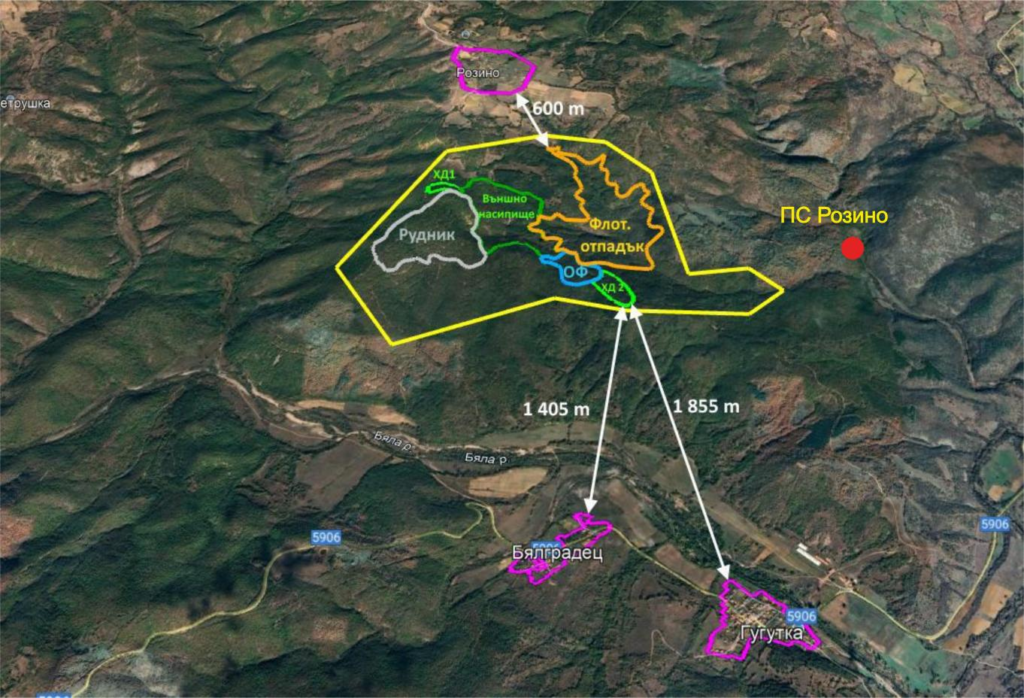
Under these conditions, if the mine is located below the catchment of Rozino PS, it will drain the massif and dry out the catchment. If the mine is above the catchment (as it actually is), including the tailings facility at Yuren Dere River, the catchment will not only be polluted but will also be totally dried out, because the pit will be 140 meters deep, and it will completely drain the Rozino PS catchment area! It is that simple!
Here is the map for you to see the mine and where is the Rozino PS:
Note:
On this map, it is clearly visible that the „facility“ for mine waste, i.e., the tailings pond, is planned to completely block the riverbed of the Yuren Dere River, but we will get back to this issue later in this Objection!
3.6.
Sixth – if this statement on page 46 is about taking 100 l/s of water from surface waters, the situation becomes even worse than what we described in section 2 above, where we demonstrated the impossibility of taking even 50 l/s, let alone 100!!!
LEGAL CONCLUSION:
The water intakes from surface and/or groundwater, as they are planned and discussed in the EIA Report to supply the technological needs of the mine and which the competent authorities have approved violate Article 50(4) of the Water Act, according to which the provision of the drinking water needs has absolute priority over the needs of all other water users!
Not only that this outrageous violation of the Water Act is being so obvious, but someone should also tell the proud investor that the water that the „experts“ promised him with their lies DOES NOT EXIST in the area, even if each drop of water will be stolen only for his needs!
IMPORTANT!!!
4. Here it is necessary to highlight the statement at the very top of page 47 in the EIA Report, which says:
„From the hydrogeological study conducted in the area of the deposit, it was found that the groundwater has an insignificant flow, and its extraction is extremely insufficient for technological needs. For optimal water use, a recirculation of part of the water will be ensured where possible, for which an open reservoir for contact water will be constructed.“
…And on page 72, the following statements are found:
„The crack waters are recharged by precipitation, but because in most cases the permeable rocks are covered by waterproof layers, this recharge is hindered.
………………………………………………………………………………….
Among these practically impermeable lithological types, groundwater circulates almost exclusively through mechanical disruptions—cracks and tectonic faults.
…………………………………………………………………………………….
The results from measurements, as well as the data from the full study, allow for the characterization of groundwater body BG3G000PtPg049 in the studied area of the Rozino investment proposal. During the indicated period, groundwater levels were found at depths from 4.82 to 31.33 m below the surface, generally following the terrain line. The water level altitudes range from 259.27 to 467.03 m. An exception is borehole RDD-056, where groundwater is drained by natural outflow at altitude 368.75 m. By type, the groundwater is classified as crack water.“
Later, on page 168, it is stated:
„The bottom of the mine is planned to reach elevation 435 m. According to the conducted drilling works, no groundwater was encountered down to this elevation; therefore, no additional water inflow into the pit is expected, except that from rainfall and snow.“
And on page 171, it is stated:
„The inflow of groundwater collecting in the sumps of the pit will be pumped to the installation as a priority to satisfy the requirements of the technological installation.“
Finally, on page 21, it is stated:
„The assessed mining reserves and resources extend to approximately 195 meters depth, with about 95% of them at depths less than 120 meters and about 1% of them below 140 meters. The maximum depth of the mine pit is planned to reach approximately 140 m from the terrain surface.“
From these quotes, the following becomes crystal clear:
4.1.
First, the statement on page 168, which implies that the open-pit mine will not expose the groundwater body in the open, is in general contradiction with the statement on page 171 that there will be an inflow of groundwater into the pit! As, we believe, you may have already noticed /or perhaps you didn’t/ – the groundwater is found at depths from 4.82 to 31.33 m below the surface, while the maximum depth of the mine pit is planned to reach approximately 140 m from the surface.
4.2.
Second, therefore the EIA Report itself proves that there is groundwater in the area of the deposit, as page 72 clearly describes the way it is formed. Even though the flow is small, such groundwater obviously exists in the area of the future pit, and the mine will be developed by open-pit method, in an open pit, which is mentioned repeatedly throughout the EIA Report. The statement that groundwater was not encountered down to the bottom elevation of the pit is a flagrant Lie!
4.3.
The above means that there are activities that will lead to the exposure of the groundwater level at the surface (since it will be collected and pumped from the pit), which constitutes a violation of ARTICLE 61(1), para 1(c) of ORDINANCE No. 1 of 10 OCTOBER 2007 ON THE EXPLORATION, USE, AND PROTECTION OF GROUNDWATER.
4.4.
In the next section, we will demonstrate that a key problem for the mining activity is the presence of arsenic and mercury among the mineralization in the affected area. Mercury and its compounds, ladies and gentlemen, are among the priority substances according to the table in Appendix No. 1 to Article 1(2) of the ORDINANCE ON ENVIRONMENTAL QUALITY STANDARDS FOR PRIORITY SUBSTANCES AND CERTAIN OTHER POLLUTANTS.
For your information, in the EIA Report, the word arsenic does not appear anywhere at all, and the word mercury is mentioned only once in the table on page 142 – where it is implied that the only source of mercury will be coming from the exhaust gases of the mine’s industrial equipment, not from its natural presence in the environment. Nowhere in the EIA Report is there any clarification on how arsenic, and especially mercury, will actually be treated.
Consequently, this constitutes another very serious violation of the aforementioned Ordinance on Groundwater, specifically Article 61(1), para 1(c), not only because no measures to prevent the direct or indirect introduction of the priority substance MERCURY into the groundwater have been envisaged, but the data on its presence has been deliberately and intentionally concealed by the „competent“ authorities from the affected public in Bulgaria, and even in a transboundary context!
5. We object to the conclusion of admissibility on page 13 of the Statement of the Director of BDIBR No. PU-01-806-6/30.01.2026
which is the current official Statement on the admissibility of the Investment Proposal (IP). In this opinion, the statement repeated by Vasil Uzunov is that the subject IP is admissible with respect to the RBMP, the Water Act, and subsidiary legislation. This is categorically not true!
Apart from the violations mentioned in the previous sections here, here are the additional reasons:
5.1. The mine area is full of arsenic and mercury!
We allow ourselves to cite here a document called Rozino Gold Project – Pre-Feasibility Technical Report, which has been posted on the project’s website by the proud investor at the following link.
On page 58 of this document, it is claimed that soil survey identified the presence of arsenic, just as the same arsenic was found in the soils at the Ada Tepe mine.
On page 46, regarding Tintyava, it is stated:
„Velocity have identified telethermal alteration at Tashlaka, characterized by hot springs silicification and associated pathfinder geochemistry such as arsenic, antimony, barium, mercury and silver.“
They also identified mercury, in addition to arsenic! Mercury vaporizes at 26°C and is extremely hazardous to human health, you know!
As for the content of the ore itself, on page 95 it is stated:
„Data from the chemical analyses on the 2018 PEA Master Composite characterize it as gold-bearing (1.28 g/t Au), with other valuable components (silver 2 g/t; copper 48 g/t; lead 28 g/t and zinc 74 g/t). The potential penalty elements in the ore are arsenic at 125 g/t and chromium 54 g/t. Antimony at <5 g/t and cadmium at <1 g/t are negligible and are not expected to affect the quality of the final products.“
Thus, it becomes clear that the arsenic content in the ore is higher than the combined content of all other metals! And we will extract 1.28 grams of gold per ton of ore, but will release 125 grams of arsenic per ton from the same ore?
Where will this arsenic go or be disposed of, and it will not leave a single drop of water uncontaminated?
Furthermore, the extraction of polymetallic ores rich of arsenic and mercury will be carried out by open-pit mining with blasting, in a pit that cannot be waterproofed and will reach 140 meters in depth in a cracked area… Meanwhile, the tailings pond (i.e., the flotation mining waste facility) will be located in the Yuren Dere River, the gully of which will be buried to the top, with all the resulting consequences, including increased flood risk…
5.2.
According to EARBD, the groundwater body BG3G000PtPg049 is in good chemical and quantitative status.
On the other hand, EARBD claims admissibility of an IP that includes open-pit mining of sulfide polymetallic ores with blasting, open area for ore storage, large area for mining waste stockpiles, flotation, an open tailings pond for the flotation waste, and so on.
And still the groundwater body BG3G000PtPg049 is formed from cracked waters in the Proterozoic.
Have you ever heard of open-pit mining of sulfide polymetallic ores with blasting that hasn’t poisoned the waters? Especially here, where every drop of contaminated water will flow through the cracks directly into the groundwater body!
For example, what happens when it rains in the pit? Will they pump the water before it enters the cracks? There are NO guarantees that water from the pit will not enter the cracks, especially due to the constant blasting. Or later, as at Ada Tepe mine, will you claim that the detected tremendous quantities of arsenic in the river sediments of Krumovitsa River were due to natural processes?
Regarding the tailings pond /pardon – the „flotation mine waste facility“/:
In many places in the EIA report, it is stated that waters, both contact and non-contact, will be collected in isolated reservoirs, so they will not enter the groundwater. In other places, it is mentioned that the tailings pond (page 164 and following) will not overflow even in a 1000-year flood event, and that the inflow of contact water from it into the groundwater will supposedly be prevented by an injection curtain.
In section 3.5 on page 6 of this Objection, the tailings pond (flotation waste) is shown, which will cover a large area of the riverbed and hills surrounding the Yuren Dere River, and according to the „experts“, it will possible to prevent water from the tailings to enter the groundwater by using injections. WITHOUT waterproofing, only injections? Really, esteemed friends, Do you truly believe that, given that mining will be carried out with continuous blasting, and HOW exactly will injection under the bottom of the tailings pond be done?
And the open mining waste stockpiles, which are AGAIN in the Yuren Dere riverbed – are they not going to release toxic water during rains? Why don’t you go and see the disaster on the Malak Iskar River under Elatsite mine after every heavy rainfall?
So, we have a groundwater body, fed by crack waters, which is in good chemical status but is about to be polluted through the cracks by contaminants from the open pit, the stockpiles, and under the bottom of the tailings pond, and Yuren Dere will also be polluted from the stockpiles during every heavy rainfall!
This means that the requirement of the Water Act and its supporting documents to prevent deterioration of the status of the surface and groundwater bodies is breached! And the groundwater body is supposed to be a drinking water protection zone according to EARBD itself? Quite a „protection,“ indeed!
This is also applicable to all groundwater abstraction sources (springs) that are unknown to EARBD but are likely, according to EARBD itself, to be sources of drinking water for the settlements in the vicinity of the mine.
Well, if they are likely to exist but are unknown to you, how do you declare admissibility of the IP? Does the law make a distinction between sources known to you and those unknown to you, and for the latter, do the legal requirements not apply? Apparently, you have never heard about the Precautionary Principle, to breach it so easily!
6. And the most horrifying part is that the tailings pond (438.4 ha)
—which we no longer call a tailings pond but a flotation waste facility – together with the mining waste stockpile, is planned to be constructed in the bed of a living river: Yuren Dere.
The map on page 120 of the EIA (see section 3.5 on page 6 of this Objection) clearly shows the facility/tailings storage and the stockpile. And this „act“ is supposed not to adversely impact the status of the surface and groundwater bodies, according to EARBD?
Have they ever seen a tailings pond in real life? And the status of the buried river Yuren Dere would not deteriorate? Well, it really will not deteriorate, because it will be completely destroyed and will disappear in the area of the mine 100%!
But the flotation waste is supposed to be thickened up to 70–75% solids (EIA, page 34 and following)? Well, even if it is thickened up to 100%, if a heavy rainfall hits and fills the tailings pond almost to the top /while the EIA „experts“ claim the tailings pond will not overflow/ what does it matter if the tailings were thickened? Not to mention that at 100% of the locations, they still refer to it as ordinary tailings! For example, on page 166 – where the following is stated:
Outflows from the mining area:
- Evaporation from water surfaces in the open pit, the tailings pond, and the reservoirs for contact and fresh water;
- Water attracted in the tailings and/or filtration flows from the tailings pond;
- Water for human use, consisting of 50 liters per person per day for up to 300 staff personnel (75% of which is returned after treatment through the tailings pond for use in the production facility); and
- Water for irrigation, varying through the months from 140 m³ (February) to 10,510 m³ (August) and taken from the tailings pond;
- Forced evaporation via an installation of evaporators to control the level in the contact water reservoir.
And the most amazing part is that the irrigation water is supposed to be taken from the tailings pond, not to speak about the „evaporated“ water from the dirty contact reservoir! And when all affected areas are irrigated – including stockpiles, crushing installations, site roads, etc. – then during some rainfall, all this toxic water will flow into the surrounding rivers – that part of the water that didn’t evaporate and didn’t drain into the groundwater in the entire mining area, where there is no protection against the migration of surface waters into groundwater! And who will breathe the „evaporated“ dirty contact water not only in the mining area, but in the surrounding settlements when the wind blows?
We see such a Wonder of the Wonders for the first time, approved by a supposedly „competent“ authority, and we were thinking we had seen everything possible so far!
And when this irrigation dries up, what will the surrounding villages breathe, and especially the mine workers, please? Or do these mining sites, roads, and facilities never dry out? The crushing plant is supposed to be irrigated with toxic water from the tailings pond – what will the workers breathe?
And just figure out how much water is actually available in the area for technological needs, when for dust suppression they rely on water from the tailings pond???!!! This is to confirm 100% our statement that there is no way to find water in the area enough for the technological needs – tell the investor that he has been deceived!
In addition to the above, having in mind that for the mining waste stockpile and the tailings pond all forests located in the area will have to be cut down, and that the area falls within a Natura 2000 protected site, the current RBMP 2025–2027 of the EARBD includes numerous measures and actions that introduce several bans applicable to the entire River Basin, for example:
- HY_1_39 – Ban on cutting natural riparian vegetation within 15 m of the boundares of a surface water object.
- HY_1_3 – Survey of the riverbed and implementation of measures to restore its natural state.
- HY_7_315 – Ban on new modifications of river sections located within protected territories and Natura 2000 protected sites (except for settlements within these protected sited).
- HY_7_316 – Prevention of new negative modifications of the hydro morphological regime of water bodies with identified significant hydro morphological pressure.
- HY_7_312 – Prevention of new negative modifications in the hydro morphological regime ( i.e. caused by HPPs, removal of sediments from reservoirs, new water intakes, etc.) in water bodies designated or located in water protection zones under Art. 119a(1), para 1, 4, and 5 of the Water Act, except in cases where a justified exemption under Art. 156e of the Water Act / Art. 4(7) of the RDW is applicable.
…And they plan to preserve and restore the natural state of the riverbed applying measures to fill it to the top with poisons in the tailings pond, and why is the EARBD director Vasil Uzunov, completely ignoring these measures and bans in every statement on permissibility, please! And why is he still a director? How can you fill a riverbed wit poisons without cutting the riparian vegetation first, and then claim that this poisonous filling will be used to backfill and „reclaim“ the huge mine open pit?
Legal conclusion:
Filling the riverbed of Yuren Dere with stockpiles and tailings pond constitutes a flagrant violation not only of the RBMP, but also of the entire meaning and spirit of the Water Act and the relevant EU Directives and UN Conventions!
In our country, besides the poisons from the stockpiles at Elatsite mine, there is another notorious precedent – the Erma River tailings pond back in the deep Socialist times – and the whole world knows what happens every time the tailings overflow into the Varbitsa River during high waters. Incidentally, the Erma River is also in a territory unfortunate enough to fall under the management of EARBD, so they are used to poisoning our rivers all right!
8. And yet, the most horrifying fact is that, just like the surface water body Byala Reka and its tributaries (code BG3MA100R270), the groundwater body (code BG3G000PtPg049) is TRANSBOUNDARY!
And since the „competent“ authority, with great reluctance, initiated the EIA procedure in a transboundary context nevertheless, and the current EIA has been translated in Greek, obviously to mislead the Greeks -we therefore inform you that we have already notified the Implementation Committee of the Espoo Convention about the fact that your beloved EIA contains not a single word about the Arsenic or about the Mercury.
The Greeks hope to use the waters of Byala Reka for irrigation, and you know what their farmers will do when they see what kind of water they are using…
Given the dreadful cumulative effect on surface and groundwater bodies, as well as the destruction of Yuren Dere River, including the risks that during every heavy rainfall the waters from the tailings pond /sorry, the Mining Flotation Waste Facility/ and from the stockpiles, roads, etc., irrigated with water from the tailings pond, will flow directly into neighboring Greece, how can you possibly think, or really believe, that this project will even be feasible? And if it still goes ahead, how will the Greeks react when they see what water they are receiving?
We have already dealt with similar polluters in Serbia (Podvirovi mine – Bosilegrad) and in North Macedonia (Ilovitsa – Shtuka mine, in the Strumica region), so are we not going to deal accordingly with you, dear friends? Do you really believe that?
9. Cumulative effects have not been properly assessed at all!
In Appendix 14 of the EIA, a large number of IPs (Investment Projects) are described in the form of a Comprehensive Work Project for the exploration of all types of non-metallic construction and tiling materials. The following future /in past tense/ metal mining projects related to the Rozino deposit are also listed:
Kesebir, Iran Tepe, Kondovo, Blagun, Tintyava, Elhovo, Chiirite, Khan Krum, Krumovitsa, Chukata.
The „experts'“ conclusion is that there would not be any cumulative effects from the mining activity in the Rozino area and the above new mines, even though many new mines are missing from the list in the EIA report. Here is the map of the licenses issued by the Ministry of Energy, showing the active exploration and prospecting permits for metallic mineral resources in:
Ivaylovgrad municipality:
https://dams.reki.bg/uploads/Docs/Files/IVGR_MAP_1.jpg
Krumovgrad municipality:
https://dams.reki.bg/uploads/Docs/Files/KRU_MAP_5.jpg
It is evident from the maps that around 70% of the territories of the two municipalities bordering Greece will be excavated extensively to extract gold and other metals. All these activities will take place over the same groundwater body BG3G000PtPg049, which is formed by cracked Proterozoic waters and is transboundary, and by the way, the entire area is full of arsenic, which was proven also by the Ada Tepe mine!
All the current and future mines in the Eastern Rhodopes are part of the Mining Industry Development Strategy, which has not been subjected to Strategic Environmental Assessment (SEA) and/or to an Appropriate Assessment (AA). The Krumovgrad municipality’s General Spatial Plan has deliberately not been finally approved for many years because, with all the mines there, it could never pass through SEA and AA. In the Ivaylovgrad municipality’s General Spatial Plan, we do not find the current Investment Project among the mining activities shown on the map „System of labor, production, and storage activities,“ which can be accessed at the following link:
https://ivaylovgrad.bg/wp-content/uploads/2017/09/5_Карти-и-схеми-ОУП.pdf
Therefore, the current Investment Project has not even been assessed together with the other mining activities within the Ivaylovgrad municipality under the Strategic Environmental Assessment (SEA) and the AA procedures of the municipal GENERAL Spatial Plan. These new mines clearly require an amendment to the Plan and a new SEA/AA procedure for the amendment!
It is also undeniable that all these intentions in the two municipalities, Krumovgrad and Ivaylovgrad, constitute a plan-program for the „bright mining future“ of the region. In this context, we find that there is already a brutal violation of the SEA Protocol under the ESPOO Convention, about which we have already informed the Implementation Committee of the Convention, and we will also inform the affected Greek party, because the Greeks will soon be producing metallic tomatoes and other vegetables!
In fact, the data from the maps in the links are not entirely accurate. The Rozino deposit, Tintyava area, was owned by a joint venture between Velocity Minerals and Gorubso, for which many interesting details can be found at the following link:
https://minedocs.com/30/Velocity-Minerals-3Q-2025-MDA-09302025.pdf
So, on page 6 of this optimistic paper, it is said that the joint venture between Velocity Minerals and Gorubso collectively holds projects for prospecting and exploration of metals over an area of 10,400 (TEN THOUSAND FOUR HUNDRED) square kilometers, dear friends! That’s one-tenth of the country’s territory just for these „heroes“.
It is of little consolation if any that they actually sold the project to Turker Mining, and frankly, we don’t fully understand whether their Rozino project and the Tintyava area correspond exactly to the current Investment Project or are different areas – but that is unimportant.
In any case, it is obvious that you are preparing to kill not only the Eastern Rhodopes but the entire country with new mines, without proper procedures under the national and international law, and without any assessment of cumulative effects. But rest assured: we will make sure your violations are exposed at both the national and international levels.
REQUEST
Dear Ladies and Gentlemen,
Based on the above, we demand the immediate termination of the procedure under Chapter Six of the Environmental Protection Act, and that EARBD prepares a new statement explicitly declaring that the current Investment Project is inadmissible under the RBMP, the Water Act, and even under common sense.
Despite our extensive experience with the authorities at Maria Luiza 22, we have never, ever encountered such an incredible Fraud as presented in the current Environmental Impact Assessment! A new mining project with a tailings pond in the bed of a living river and irrigation of the entire mining area with water from the tailings pond in the 21st Century?!
Furthermore, in the light all areas granted by the Ministry of Energy for exploration and prospecting of metal ores, which cover 70% of the Eastern Rhodope Mountain, in relation to the currently active mines in the same region, we declare our preparedness to inform both the European Commission’s DG Environment and the Implementation Committee of the ESPOO Convention, as well as the affected Parties to the Convention, about how you „protect“ the water in our country.
Not to mention the protection of the Natura 2000 network, for which we already have a case pending in the European Court against Bulgaria!
We request the immediate termination of the procedure under Chapter Six of the Environmental Protection Act and once again request that EARBD issues a new statement declaring the current Investment Project inadmissible.
We ask that you notify us of the actions you have taken regarding this objection at the email address shared at the beginning, by sending a scanned copy of all your future decisions. This will allow us to prepare together for any potential further actions under the Administrative Act, if necessary.
Finally, we warn you /like we did in the Petrohan case/ that you may do everything possible to push this Fraud ahead; you might even mislead the staff at the Greek Ministry of Environment into agreeing to it. However, when the Greek farmers eventually discover the kind of water they are using to irrigate their crops, an international scandal will arise. By that time, it may be too late to remedy the damage in Bulgaria, and the mine will have to be closed just as it happened with Podvirovi mine in Bosilegrad, Serbia, despite your usual inaction in that case.
So far, the Krumovitsa River pollution has managed to „escape“ the scandal just because its polluted waters flow into the Arda River and are deposited in the Ivaylovgrad Reservoir. But for the Byala River, there is no such retention, and the full extent of your negligence will be revealed immediately, once the toxic elements hit the river and reach Greece.
We hope that this document, appropriately supplemented with data and evidence regarding all future similar mining Projects in the Eastern Rhodope Mountain, will not be read across Bulgaria and Europe.
Thank you in advance for your understanding and cooperation.
Balkanka Association, Sofia
Date 05.04.2026
SUPPLEMENT to OBJECTION
Against: EIA Report for an Investment Proposal (IP) for „Extraction and processing of polymetallic ores from the exploration area ‘Rozino – ‘deposit ‘Tintyava’, located within the lands of the village of Rozino and the village of Gugutka, Ivaylovgrad Municipality, Haskovo Region“
Submitted by: Association „Balkanka“, city of Sofia, 26 Chelopeshko Shose St.
Dear Ladies and Gentlemen,
On 05.04.2026 we had the pleasure to send you a motivated Objection against the present Investment proposal /IP/, which I believe you have taken into consideration. After additional study of the Fraud in the EIA Report for the same IP, we find it necessary to add additional reasons of a substantive nature, which, following the numbering of the previous document, we now present to your attention:
And so, our additional reasons for objection are as follows:
10. We object to the overall Fraud regarding water protection, which becomes crystal clear from what is written on p.166 of the EIA Report, cited by us in the main Objection:
Outgoing flows:
- Evaporation from the water surfaces in the open pit mine, the settling pond of the tailings facility and the reservoirs for contact and fresh water;
- Water entrained in the tailings and/or filtration flows from the tailings pond;
- Water for human needs, consisting of 50 liters per person per day for personnel of up to 300 people (75% of which, after treatment, is returned through the tailings pond for use in the production installation); and
- Water for sprinkling, varying over the months from 140 m³ (February) to 10 510 m³ (August) and taken from the tailings facility.
- Forced evaporation through an installation of evaporators to control the level in the contact water pond.
…………………………………………………………………
In addition to the problems described in the main Objection, from this statement of the authors of the EIA Report it becomes clear THAT:
- Among the outgoing flows there will also be filtration flows – from the tailings facility to the groundwater! Thus the Fraud in the statements of the authors of the EIA Report, namely that there would be no filtration from the tailings pond to the groundwater becomes clear, since it would supposedly be prevented only by some kind of injection curtain, not by proper hydro insulation.
- The level of the contact water pond will be granted by an installation of evaporators, to prevent potential overflow? The capacity and the power of this installation is not specified, and where the electricity would come from is unclear, BUT this is a small problem.
The big Problem here is that the evaporated water will spread freely into the air AND, together with the sprinkling of the entire mining area and the facilities with water from the tailings pond, represents an unprecedented threat to the health of the population from the surrounding villages and especially to the workers in the mine! We point this out this especially to the mayors in the area concerned, because they are hoping for new jobs. Nice jobs, no doubt!
This is a 19th-century type of mine, dear mayors, where the workers were dying like flies.
11. We also object to the overall organization of the mining production activity, based on the following reasons:
- In the EIA Report, the content of hazardous substances and highly carcinogenic heavy metals and metalloids such as arsenic, cadmium, chromium, which will enter the circulating waters of the facilities, is not examined. Analytical certificates from laboratory tests are lacking. It is mentioned that the imbalance waters will be dispersed and used for sprinkling the sites and roads, and evaporated into the atmosphere through dispersion guns. These waters also contain residual concentrations of the reagents used in the processing plant and such measures are unacceptable.
- In the annexes from the study of samples in an accredited laboratory of flotation waste and concentrate, the contents of heavy metals and arsenic are not indicated. The arsenic content in the flotation waste, which enters the tailings pond, has not been specified. The arsenic content in the water extract from the flotation waste has also not been studied or presented. The situation has the usual character of complete Fraud, given that the whole world knows about the presence of arsenic in the mineralization of all territories of the Eastern Rhodope Mountain, and this arsenic is also confirmed by the investors as a penalty element for the extraction in their own documents, attached as evidence in the main Objection.
- As a result – no data for the arsenic contents in the concentrate (final product) from flotation, as well as in the flotation waste, is clarified, which leads to a lack of assessment of the dissolution and migration of this extremely dangerous element in the groundwater body under the tailings pond and in the so-called contact water reservoir. And the waters from the tailings pond will filtrate into the groundwater /see section 10/ and this Marvel is written fair and square in the EIA Report itself!
- The cumulative effect of hazardous substances in the production waters has not been studied
- A polymetallic deposit is indicated, but no measures have been taken for the formation of the dumps for surface soil; will there be dangerous oxide mineralization; where oxide ore and other material containing sulfides and other minerals with low content of target components, subject to natural leaching by the autochthonous microflora, bacteria oxidizing pyrite and generating sulfuric acid, will be stored. As a result, acidified drainage waters with low pH and high content of heavy metals and arsenic will be formed, and there is not a single word about this Issue in the EIA Report.
- The project does not include a waste water treatment plant for drainage and mine waters. As we have already pointed out – no measures are included for the management of these waters aiming to prevent the pollution of the surface and groundwater bodies. In fact, the „management“ will consist in dispersing these waters in the air during the sprinkling of the entire territory of the mine and during their evaporation, and from there – directly into the groundwater, into the rivers, and into the organisms of the human population and the workers.
- Given the high content of arsenic, chromium and other metals, the EIA Report does not study their impact on the other components of the environment at all.
- It is stated that regarding water quality, the production activity does not pose a threat, which is an obvious Lie.
- The extraction, processing and treatment of ores by open-pit method to a significant extent has a negative impact on the water quality – there is no mine in our country that makes an exception, even the commendable Ada Tepe, which in 2020 was caught by the competent EARBD and RIEW Haskovo discharging mine waters into the Krumovitsa River – even though it was also supposed to have „zero“ discharge, a closed cycle and similar nonsense. This happened in much better times for these two institutions, even though they did not even impose any penalty or fine to the operator.
- In the EIA Report, as well as in the project, no measures are included to reduce the impacts. On the contrary, the technical solutions for reducing the volume of imbalance waters through evaporation, sprinkling withh polluted water and other brilliant ideas are destructive to all the components of the environment, to the population in the region and to the workers in the mine. No technical solutions for the management of drainage and mine waste waters are included or considered, except for their sprinkling and evaporation without treatment, not that such a treatment to the required degree of purity is even possible for such poisons.
In the light of the above and in line with the reasons shared in our main Objection, we support the following:
REQUEST
Dear Ladies and Gentlemen,
Based on the above, we demand the immediate termination of the procedure under Chapter Six of the Environmental Protection Act, and that EARBD prepares a new statement explicitly declaring that the current Investment Project is inadmissible under the RBMP, the Water Act, and even under common sense.
Despite our extensive experience with the authorities at Maria Luiza 22, we have never, ever encountered such an incredible Fraud as the one presented in the current Environmental Impact Assessment! A new mining project with a tailings pond in the bed of a living river and irrigation of the entire mining area with water from the tailings pond in the 21st Century?!
We request the immediate termination of the procedure under Chapter Six of the Environmental Protection Act and once again request that EARBD issues a new statement declaring the current Investment Project inadmissible.
We ask that you notify us of the actions you have taken regarding this objection at the email address shared at the beginning, by sending a scanned copy of all your future decisions. This will allow us to prepare together for any potential further actions under the Administrative Act, if necessary.
In addition, we also inform you that we have already notified some European and international organizations, as well as some of your neighboring organizations and state authorities. You can get an idea about the first encouraging reactions from the Greek side at the following link:
If you run translation of this article into Bulgarian, you will find the best for you is yet to come, if you do not back off on time!
Thank you in advance for your understanding and cooperation.
Balkanka Association, Sofia
Date 13.04.2026